Fate Wheel Guide
Complete guide to Fate Wheel mechanics and optimization
Important Notice
To truly understand how the Fate Wheel system works, you need to read through all three parts of this guide. Each section builds upon the previous one to give you complete mastery of the system.
Element Specialization in Fate Wheel
Each SSR Fate Wheel Shard specializes in a primary element, with one or more secondary elements.
Example
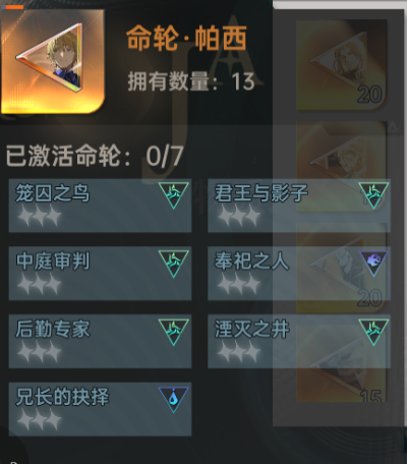
The Parsi SSR Shard has:
Primary Element: Wind
Secondary Elements: Water, Spirit
CN players commonly refer to this shard as:
- Inner Wind Shard
- Outer Spirit / Water Shard
Inner vs Outer Shards
What does "Inner" and "Outer" mean?
Inner Shard
An Inner Shard is a shard that heavily specializes in a single element.
For example, Parsi contains a large amount of Wind element, which is why it is considered an Inner Wind Shard.
Outer Shard
An Outer Shard is a shard that contains only a small amount of an element.
In Parsi's case, it has only one Water and one Spirit element, so it is also considered an Outer Water / Spirit Shard.
Why is it important to identify Inner and Outer Shards?
When optimizing (min-maxing) the Fate Wheel, the goal is to use the fewest shards possible while gaining the highest Battle Power and elemental bonuses.
Understanding Inner and Outer Shards allows you to:
- Identify which shards provide the most elemental value
- Avoid wasting upgrade resources
- Build more efficient shard combinations
Additional Explanation
Inner Shards
- •Contribute the most to your Fate Wheel
- •Strongly specialize in one element
- •Highly flexible and compatible with many other SSR shards
- •Offer more possible shard combinations
Because of this flexibility, Inner Shards should be upgraded last in the Fate Wheel.
Outer Shards
- •Contribute less to your Fate Wheel
- •Weakly specialize in your focused element
- •Less flexible and only pair well with specific SSR shards
- •Offer fewer viable combinations
Because of this, Outer Shards should be upgraded first.
Element Filter Resource
You can use the following resource to filter and analyze shard elements:
Open Element Filter SpreadsheetPractical Example
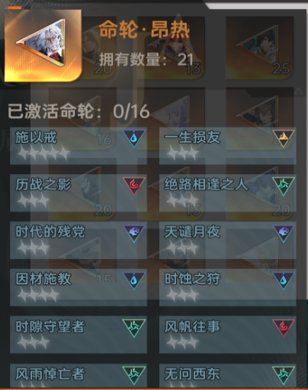
If Player A mains Erii:
They should focus on the Spirit element.
In this case, Anjou is considered an Outer Spirit Shard.
Player A should open the Spirit Fate Wheel and upgrade those shards first.
If Player B mains Caesar:
They should focus on the Wind element.
In this case, Anjou is considered an Inner Wind Shard.
Player B should leave Anjou's Fate Wheel upgrades for last.
If you've followed along and understood everything up to this point, congratulations on learning the basics of the Fate Wheel system.
Order of Leveling Each Fate Wheel
If a wheel does not specify an effect, it refers to the same effect as listed above it.
Upgrade Priority
Upgrade the remaining wheels last.
Material (Shield) should always be the final wheel to upgrade.